
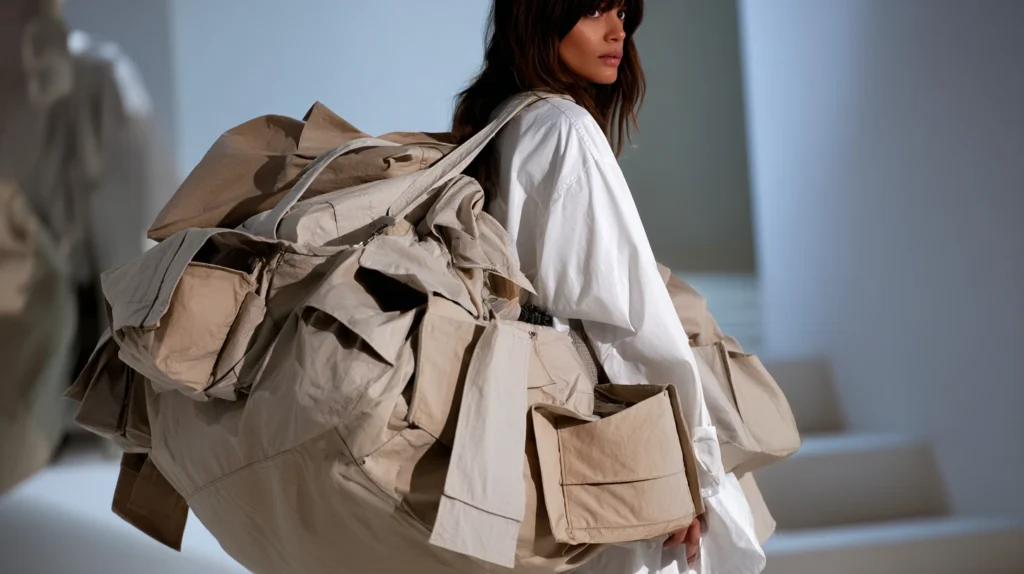
Featured Image
The Quiet Discipline of Letting Go
“Emotional weight is not always visible, but it shapes how we move, choose, and let go.”
An editorial image of a designer burdened with an oversized, layered bag. The composition serves as a visual metaphor for emotional weight—the unseen accumulation of responsibility, habit, and internal pressure—and the quiet discipline required to release it.
The Quiet Discipline of Letting Go — A Designer’s Reckoning With Weight
The marks showed up long before the meaning did. A thin red groove along my shoulder—pressed, insisted, repeated. Every morning before a shower, there it was again: a signature carved not by a bag, but by a rhythm of living I had confused with purpose.
For years, I romanticized that weight. As a designer, I believed a full bag signaled commitment—proof of a life driven by ideas. Sketch pads, swatch fragments, notation sheets, loose pens rolling like restless thoughts. If inspiration struck, I wanted to be ready. Preparedness felt like professionalism. A heavy bag, I thought, was simply the cost of ambition.
But time has its own efficiency agenda. Digital tools evolved, workflows shifted, entire creative systems moved into the cloud. Yet my bag remained stubbornly analog—still swollen with the artifacts of an old version of myself.
One day, I opened it and saw the truth without ornament: unused worksheets, untouched swatches, a notebook still crisp at the edges. Objects that once felt essential had quietly become emotional insurance—not tools, but talismans against uncertainty.
That realization carried a subtle sting: The weight wasn’t physical. It was the fear of “just in case.” The refusal to trust that I could meet the day without over-preparing for it.
And so I began a slow divestment—not of objects, but of anxieties disguised as necessities. A personal audit of what I carried and why.
As the bag grew lighter, something inside me followed. My posture shifted. My pace loosened. Even the mirror confirmed the change: one day, the red mark on my shoulder was simply gone. It hadn’t disappeared overnight; it had dissolved the moment my life stopped demanding evidence of its own busyness.
Now, moving through my fifties, I see that chapter with cleaner lines. What I clung to in my twenties and thirties were not tools of creation—but gestures of control, ways to script an unpredictable life by overfilling it.
Minimalism, for me, was never about subtraction. It was about sovereignty. Letting go not to live with less, but to live with intention. To carry only what allows you to move—lightly, deeply, forward.
Light, but deep. We move forward by carrying only what allows the soul to stay open.
