Featured Image
The Era of Fundamentalism — Returning to Humanity
“In the age of technology, the path back to humanity begins with the dignity of attitude.”
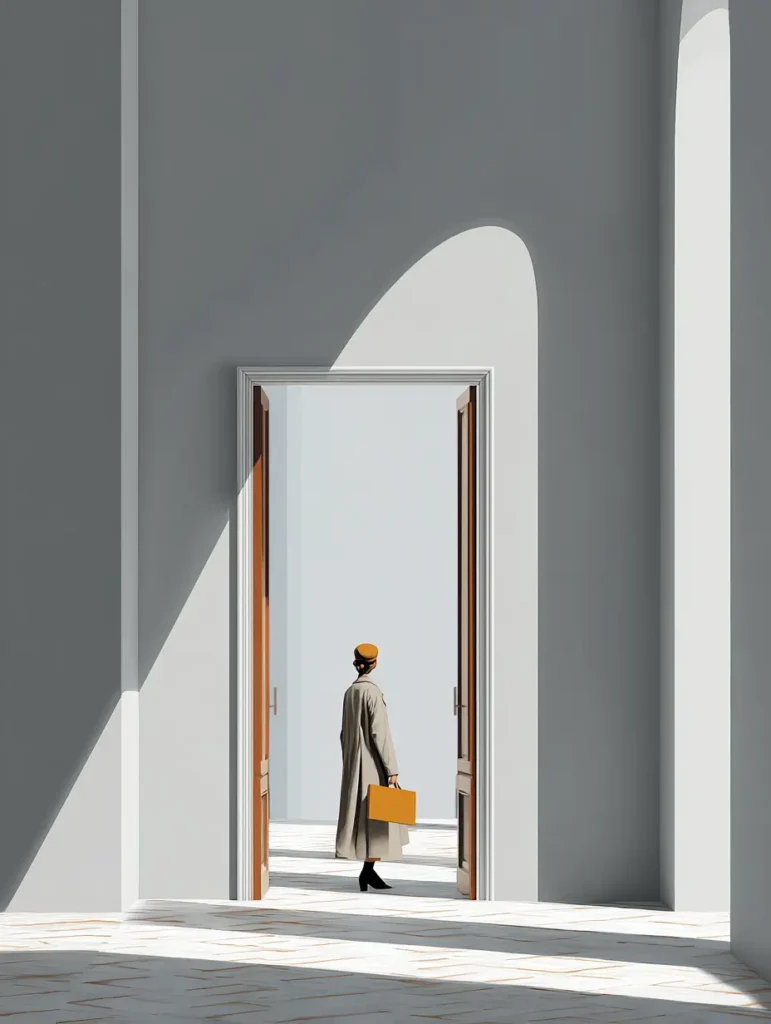
A minimalist architectural scene depicting a person walking toward an open doorway. This image symbolizes the journey back to human essence — a visual metaphor for dignity, reflection, and fundamentalism in human attitude.
Returning to the Essence- Why We Long for the ‘Human Aura’ in the AI Age
In 2026, the world begins asking again about the essence of being. As AI thinks, imitates emotions, and even creates art, people find themselves drawn back to a simple question: What does it mean to be real? The book Trend Korea 2026 calls this movement Fundamentalism —
The more AI does everything for us, the more people long for things that possess a true human aura.
But fundamentalism is not about nostalgia or regression. It’s a movement to reinterpret long-held values in the language of our time — to rediscover meaning through what is timeless. If AI represents speed, precision, and efficiency, then fundamentalism represents warmth, imperfection, and humanity — the quiet depth found in the touch of a hand, the texture of something aged, or a person’s graceful attitude.
And it is precisely here that I wish to apply this idea of fundamentalism — not to culture, philosophy, or consumer behavior, but to human relationships.
Today’s younger generation is creative and adaptive, yet in their pursuit of individuality, something essential has faded — the temperature of human connection. Speed has increased, but sincerity has grown lighter. We often say, “The older generation is too rigid,” or “The younger generation is too blunt.” But somewhere between those two lies a question worth asking: What does it mean to live as a human being with grace and integrity?
If cultural fundamentalism emerged as a reaction to technology, then relational fundamentalism is our collective response to an age of indifference and incivility. In an era when technology automates empathy and convenience replaces courtesy, it is time to revisit the fundamentals that once defined us — respect, tone, kindness, and consideration.

The Vanishing Fundamentals- When Convenience Replaces Courtesy in Relationships
We live in a time when people defend personal freedom but often forget responsibility. Many take what they want but fail to give back. Some handle their own belongings with care yet treat others’ carelessly. There are those who never fulfill their duties, unaware of how much inconvenience their negligence causes others. Others seek only comfort, avoiding effort and accountability. These small lapses, once corrected through family, school, or work, are now rarely addressed. Criticism itself has become taboo, and as a result, our sense of decency and respect continues to erode.
Human relationships are collapsing not because we’ve lost technology, but because we’ve lost attitude. What once bound us together — modesty, responsibility, mutual regard — has quietly unraveled. This is not merely a social change; it’s a cultural fatigue, a slow forgetting of what once made us human.

A Human Walking Toward the Essence
On the path toward the essence, attitude remains the deepest form of philosophy.
-An image of a man walking through a series of arches, symbolizing the human journey back to fundamentals. It visually represents how, even in the age of technology, dignity and attitude remain at the core of what makes us human.
Attitude as a Timeless Language- Restoring Nuance and The Buffer Zone in Communication
When we describe the younger generation, we often use words like direct or cool. These terms suggest a new kind of communication — fast, honest, efficient. Yet that very directness can sometimes turn into bluntness; honesty can harden into aggression. The faster our communication becomes, the less room we leave for reflection.
I believe the fundamentalism of human relations exists within this very gap — the ability to sense nuance, to speak with warmth, and to pause before judgment. The manners that once shaped social grace — respecting someone’s time, and the humility to ask not “Why are they like that to me?” but “What part of me do I need to see first?” These old virtues are what we need again.
Machines will never imitate the subtle dignity of human attitude. Our tone, our timing, our regard for others — these are the quiet measures of our humanity. In an age where efficiency is prized above empathy, attitude has become the last remaining form of human culture.
Living Together with Dignity- True Freedom Comes from Self-Governance
We cannot live doing only what we desire. That is not oppression; it is the process of maturity. Self-restraint is not repression — it is the discipline that allows freedom to exist. True liberty is not doing whatever we wish, but governing ourselves with grace.
A beautiful society does not form naturally; it is built through daily choices — how we speak, how we listen, how we honor one another’s time and presence. Every act of care, however small, reshapes the atmosphere around us. In the end, society doesn’t change through systems, but through people. When we begin to look at each other with gentleness, our collective world grows brighter, one gesture at a time.
Lightly, yet deeply. To live with grace — that is the truest form of progress.