

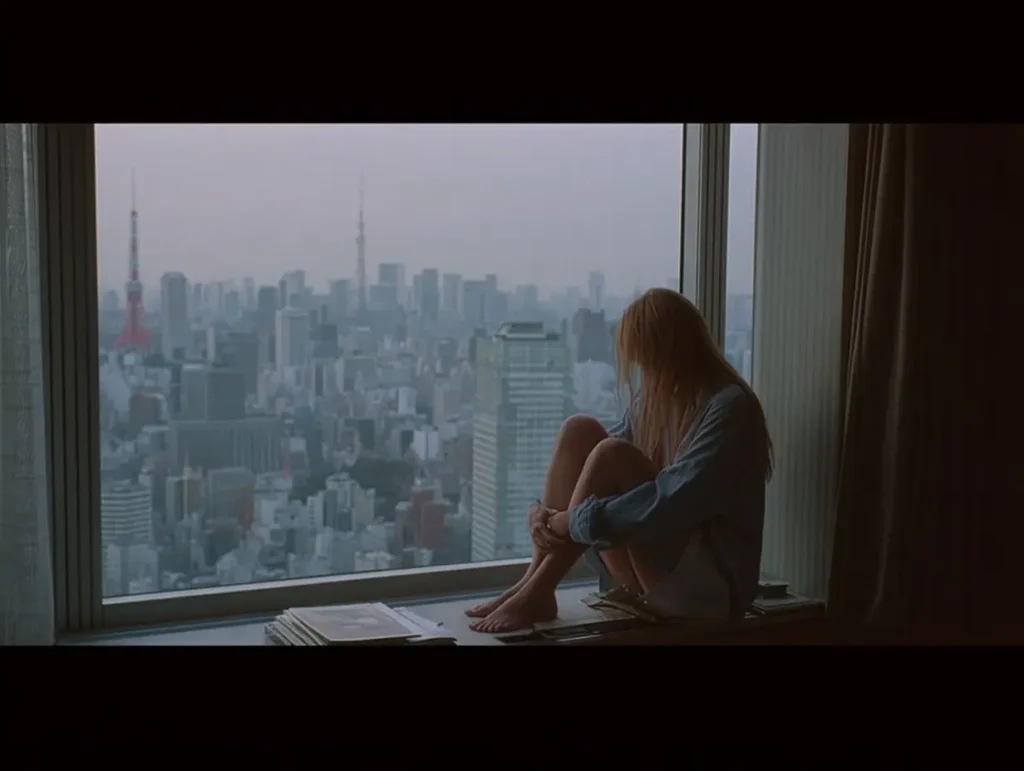
— A shared silence that says everything
This is Part Two of our Sofia Coppola series. If you missed the first essay on her debut film, The Virgin Suicides, you can explore her aesthetics of silence and repression here: [Sofia Coppola Series #1]
Tokyo at Dawn — A Light That Belongs to No One
In 2003, Sofia Coppola released her second feature film, Lost in Translation. It begins in a hotel — Park Hyatt Tokyo — a place where light and stillness cross paths, as if suspended in time. It’s said that Coppola herself wrote much of the screenplay while staying there. The film captures those sleepless hours of jet lag in a foreign city, where people find themselves awake and alone, watching the world glow quietly from their window.
I have often met myself in hotel rooms of unfamiliar cities. At that time in my life, I was buried in work — traveling from country to country, escaping to places that somehow felt more like home than home itself: Paris, Tokyo, Seoul. There were always familiar faces, familiar rhythms. The Hyatt hotels became my temporary shelters. Business trips piled up reward points, and those free nights became moments of brief but vivid escape — especially in Park Hyatt Paris and Seoul.
But Park Hyatt Tokyo remained a place I had never reached. I had imagined its quiet air, the view of Shinjuku’s night lights. And around that same time, I happened to see this film. Perhaps that’s why its atmosphere felt so real — as if I were sitting in one of those rooms, watching the soft light slip through the curtains.
Coppola didn’t capture the rhythm of a city; she captured the rhythm of solitude. She used space instead of dialogue, light instead of time. Tokyo in this film isn’t merely a city — it’s an emotional landscape, a mirror of someone’s inner world.
And in that same period of my life, I, too, was living inside that rhythm of solitude. Moving between cities, surrounded by people, yet slightly detached from them all. In those days, being alone sometimes felt like a kind of relief. So when I watched Lost in Translation, it felt as though Coppola had filmed not just Tokyo — but the silence within me.
A Room Above the City
L: One of the main settings of Lost in Translation. The city outside never sleeps, yet the stillness within feels louder.
This image evokes Charlotte’s quiet dawn in her hotel room — a space where solitude and comfort coexist between the city lights.
First Encounters Between Lights — New York Bar, Tokyo
R: The setting of Bob and Charlotte’s first encounter — where two strangers recognize each other’s loneliness in a foreign city.
Beneath Tokyo’s skyline, the New York Bar symbolizes the beginning of their connection — a silent conversation in a foreign place.
Note: These images are artificially generated.
Closer Than Words: The Quiet Ache and the Recognition of Solitude
The story follows two strangers: Bob Harris (Bill Murray), a fading actor, and Charlotte (Scarlett Johansson), a young woman adrift in her own uncertainty. They breathe the same air of loneliness — different in form, but the same in weight.
Bob is in Tokyo for a whiskey commercial. Charlotte is there with her photographer husband, often left behind in the vast stillness of the hotel.
They meet at the bar for the first time. Charlotte teases him:
“You’re probably just having a midlife crisis. Did you buy a Porsche yet?”
Bob smiles,
“You know, I was thinking about it.”
A brief, almost careless exchange — but it’s the moment their connection begins. Two outsiders, recognizing the quiet ache in one another.
Later, lying side by side on the bed, they talk softly into the night. Charlotte confesses:
“I just don’t know what I’m supposed to be.”
And Bob replies, gently:
“You’ll figure it out. The more you know who you are, and what you want, the less you let things upset you.”
There’s no confession, no promise — only understanding. Between their words, something wordless flows. They don’t lean on each other out of need; they simply recognize each other’s loneliness.
The City of Untranslated Feelings — Shinjuku at Night
L: Amid the countless lights, solitude still lingers — a reflection of Sofia Coppola’s Tokyo, where stillness breathes beneath motion.
Between Shinjuku’s endless signs and crowded streets, one can almost feel the same quiet loneliness that fills Lost in Translation.
Rhythm of Light — Nightscape of Shinjuku, Tokyo
R: A cityscape of Shinjuku, home to Park Hyatt Tokyo — the setting of Lost in Translation. A balance of light, rain, and solitude.
The neon reflections of Shinjuku’s rain-soaked streets create a rhythm of their own — a view that mirrors the quiet isolation felt by the film’s characters.
Note: These images are artificially generated.
The Aesthetics of Stillness: Where Time Pauses and Music Becomes Dialogue
Lost in Translation moves almost without plot. Coppola directs not through events, but through pauses. Long corridors, glowing windows, reflections in taxi glass — and two people sitting in silence. Each still frame deepens the emotion, until you can feel time itself breathing.
The soundtrack, too, becomes its own form of dialogue. Composers Kevin Shields, Air, and The Jesus and Mary Chain create a dreamlike soundscape that carries the city’s quiet pulse. In the final scene, as “Just Like Honey” plays, the song replaces everything that can’t be said.
In this film, silence isn’t emptiness — it’s vibration. Where words stop, music begins. Where motion ceases, empathy blooms.
Translating Emotion: The Power of the Untranslatable Whisper
The title itself reveals the heart of the film: Lost in Translation. It’s about everything that language can’t carry. Words fail, meanings blur, and yet — something deeper is understood.
The beauty of this story lies in that imperfection. They never fully explain their feelings, but they see each other anyway. Their loneliness isn’t translated; it’s shared. And that silent recognition becomes the purest form of human connection.
The Whisper
In the final scene, Bob pulls Charlotte close and whispers something we never hear. Coppola deliberately leaves it untranslated, uncaptioned. That whisper is the film’s final message — an emotion too fragile for words.
As they part on the street, it doesn’t feel like an ending. It feels like a beginning — a quiet understanding that lingers, as if the world has momentarily slowed down to let them exist.
Lightly, yet deeply. And within each other’s silence.
The Jesus and Mary Chain’s “Just Like Honey” is the most symbolic and poetic song that completes the final scene of Lost in Translation. Even after Sofia Coppola’s camera stops, the song continues to carry the emotions of her characters.
They said nothing, yet understood everything. Their silence became a song, dissolving into the Tokyo night.
Just Like Honey — The Jesus and Mary Chain
When words fail, music becomes the translation of emotion. Charlotte and Bob share their final goodbye and walk into the Tokyo streets. At that moment, “Just Like Honey” begins to play. The words they couldn’t say, the feelings that couldn’t be translated, drift gently with the sound of the guitar — tender, unresolved, infinite. Their story ends, but its echo lingers.
“Perhaps love is an understanding that arrives before language.”
“Even after goodbye, what remains is the echo of an untranslatable feeling.”
Here, he wasn’t just an actor — he was deeply, quietly human.
In this film, Bill Murray felt far more captivating than Scarlett Johansson. There was a quiet kind of sensuality in him — something I’ve never quite seen in any of his other roles. Maybe it was his humor, his loneliness, or the way he simply looked at the world. While Scarlett portrayed the confusion of youth at seventeen, Bill embodied the warmth that lingers even within emptiness.
To Sofia Coppola
This film is one of the greatest in my life. Quiet yet profound, it touched every corner of my solitude and emotion. In the final scene — when Bob steps out of the taxi, finds Charlotte, and embraces her in silence — I couldn’t stop the tears from falling. In that moment, words disappeared, and their silence explained everything. I have deep admiration for Sofia Coppola — for her sensitivity, her vision, and her quiet warmth. Her camera captures the human heart more truthfully than language ever could.
A filmmaker who understands emotion before words — that’s Sofia Coppola.
In the next installment, we turn to Coppola’s visually sumptuous yet thematically isolated historical drama, Marie Antoinette. Join us to explore the loneliness behind the splendor and the tragedy of a life lived for spectacle in [Sofia Coppola Series #3]!
